
For agency owners, managers and CSRs
Count your tabs: a 20-minute audit of what one policy change really takes.
Pick the last vehicle your CSR added to a policy. Now count how many tools it took.
Nobody chose to run an agency this way. The AMS came first, then the carrier portals, then a shared folder, then a spreadsheet because the AMS report never showed what you needed. Each one made sense on the day you added it.
The cost doesn't appear on any invoice. It shows up as the same VIN typed three times, a note that never made it to the file, and a client asking something only one CSR can answer. You can measure it in about 20 minutes, with one real policy change and the worksheet at the bottom of this page.
The audit
How to run it.
- Pick one real change from this week. Personal lines: a vehicle added to an auto policy. Commercial lines: a location added, or a certificate issued for a new contract. Choose a routine one, not your worst nightmare.
- Sit with the person who did it. Don't work from memory, and don't let the owner describe it. Ask them to walk through it on screen.
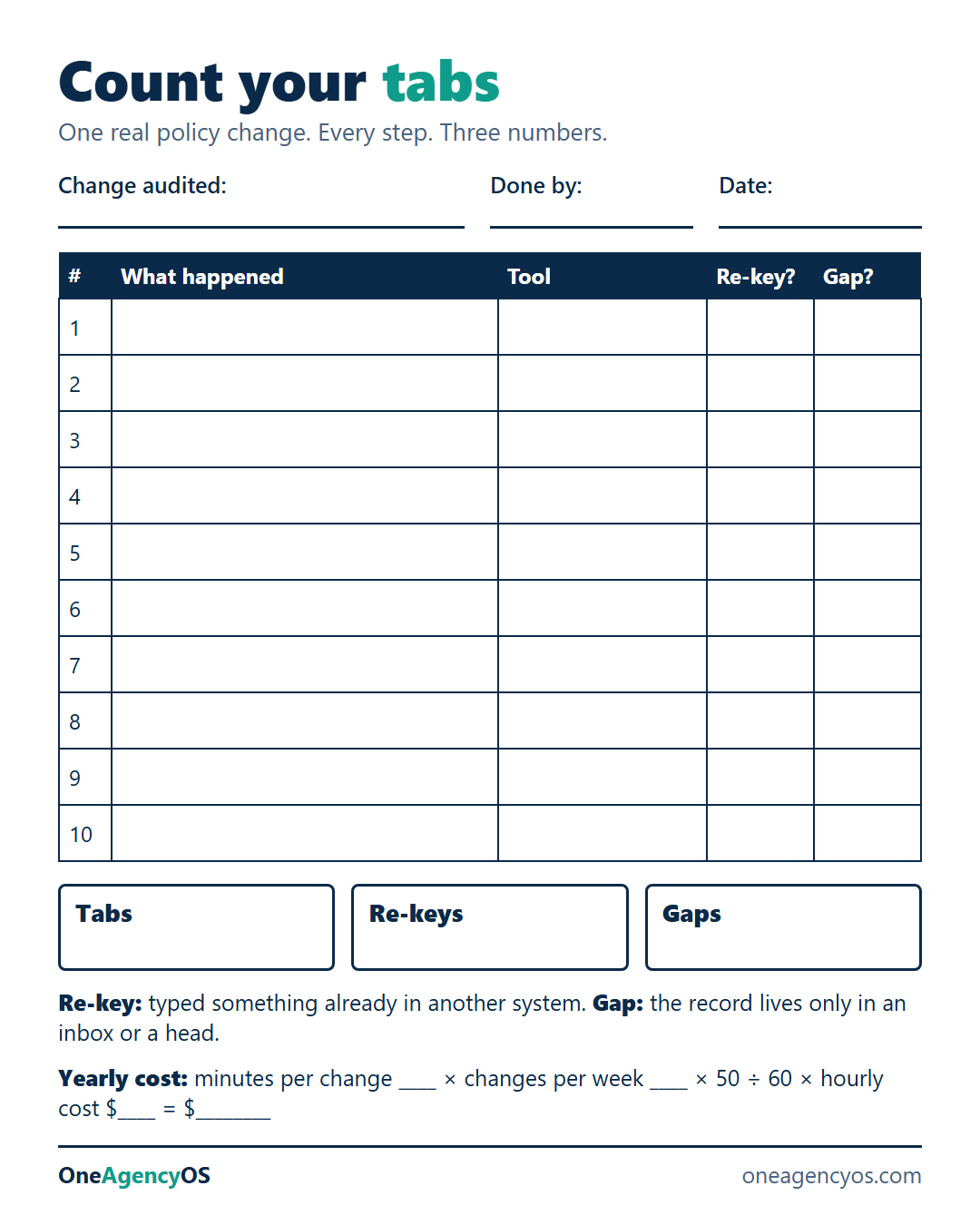
- Write one row for every step. What happened, which tool it happened in, and whether anyone typed something that already existed somewhere else.
- Count three numbers. That's the whole audit.
What you're counting
The three numbers.
- Tabs: how many different tools the change touched.
- Re-keys: how many times someone typed information that was already in another system.
- Gaps: how many steps left a record only in someone's inbox, or in their head.
A worked example
Adding one vehicle.
This one is made up to show the method, so don't treat it as a benchmark. Count your own.
- Client emails the VIN and lienholder. Outlook.
- Open the client record. AMS.
- Process the change with the carrier. Carrier portal, re-key.
- Save the new ID card and dec page. Shared folder.
- Add the vehicle to the policy record. AMS, re-key.
- Email the ID card to the client. Outlook, gap: the only copy is in one mailbox.
- Send evidence of insurance to the lienholder. PDF form, re-key.
- Note the file. AMS, re-key.
- Update the follow-up tracker. Spreadsheet, re-key.
Result: 6 tabs, 5 re-keys, 1 gap. One routine change.
Reading the result
What your numbers are telling you.
- Re-keys are your error rate. A VIN typed three times is three chances to get it wrong, and the mistake usually surfaces later, on a certificate or a claim.
- Gaps are your Friday problem. If this CSR is out on Friday and the client calls, can someone else see what was sent? Every gap is a step the agency can't see, and it's the first thing you'll want when a client disputes what they were told.
- Tabs matter less than you'd think. Some tabs are never going away. Carrier portals are carrier portals. A high tab count with few re-keys is annoying. A low tab count with many re-keys is the expensive one.
The cost
Put a dollar figure on it.
Use your own numbers, not anyone's industry average:
Minutes spent re-keying and searching per change × changes per week × 50 weeks ÷ 60 × your loaded hourly cost = what this costs you per year.
Then run it on your next most common change. That's usually when owners stop thinking of it as a small problem.
What to do next
Three fixes that cost nothing.
- Kill one re-key this week. Choose the one that happens most, and see if a template, a saved form or a copied block removes it.
- Pick one home for notes. The rule is "if it isn't in the file, it didn't happen." Sent emails and documents go in the file the same day.
- Close your biggest gap. If the record of a step lives in one mailbox, change where it lands.
Then rerun the audit on a commercial change. The count usually looks different, and that's useful to know.
Where software fits
Built around the client file.
This audit is why we built OneagencyOS around the client file. Email from known clients files to the client's timeline when your Outlook mailbox is connected. Documents, quotes, notes and calls sit on the client record. Evidence of insurance and mortgagee documents are built in the system, and e-signatures, the client portal and communications are part of it too.
We won't tell you the count goes to one. Carrier portals are still carrier portals. But re-keys and gaps are the numbers that cost you, and those are the ones worth moving.
Bring your worksheet to a demo.
We'll walk through that same change in OneagencyOS, so you can compare your count for yourself.